Development Management is planned. This page describes what we intend to build; none of it is available today.
Development oversight, planned into the platform where the deal began
Development Management is the pillar we plan to build beside Property Discovery, Investment Analysis, Capital Allocation and Portfolio tracking: one record of each project’s budget, schedule, contracts, draws and risks, read against the underwriting that justified it.
From Investment Opportunity to Completed Development
One connected vision for real estate investing and development — bringing property intelligence, financial planning, project oversight and portfolio tracking into a unified platform.
- 01
Discover
Status: AvailableStatus: Available
Research sites and properties in public parcel records and labeled listing snapshots, and rank stored listings against your buy box.
- 02
Analyze
Status: AvailableStatus: AvailableStatus: Planned
Underwrite rentals and flips with your own assumptions and know the most you can pay. Development and land feasibility models are planned.
- 03
Acquire
Status: AvailableStatus: Planned
Move each opportunity through clear stages to a recorded decision. Offer-to-closing workflows are planned.
- 04
Develop
Status: Planned
The planned pillar: budgets, schedules, contractors, change orders and lender draws for each project, measured against the plan.
- 05
Manage
Status: Available
Keep acquired and completed properties in one portfolio view, with the figures you record.
- 06
Optimize
Status: Live PrototypeStatus: Planned
Compare ways to deploy capital under your own assumptions. Portfolio and development analytics are planned.
Why development belongs next to underwriting
A development succeeds or fails against the assumptions that justified it: the land basis, hard and soft costs, the schedule, the financing and the exit. Those assumptions usually live in a pro forma that stops changing the day construction starts, while budgets, contracts, invoices and draw packages move into separate spreadsheets and inboxes.
We plan to keep them connected. Every change order, schedule slip and draw request would be read against the original underwriting, so that owners, investors and lenders work from the same clearly labeled figures — and so that a variance is visible when it is a decision, not after it is a loss.
One view of every project
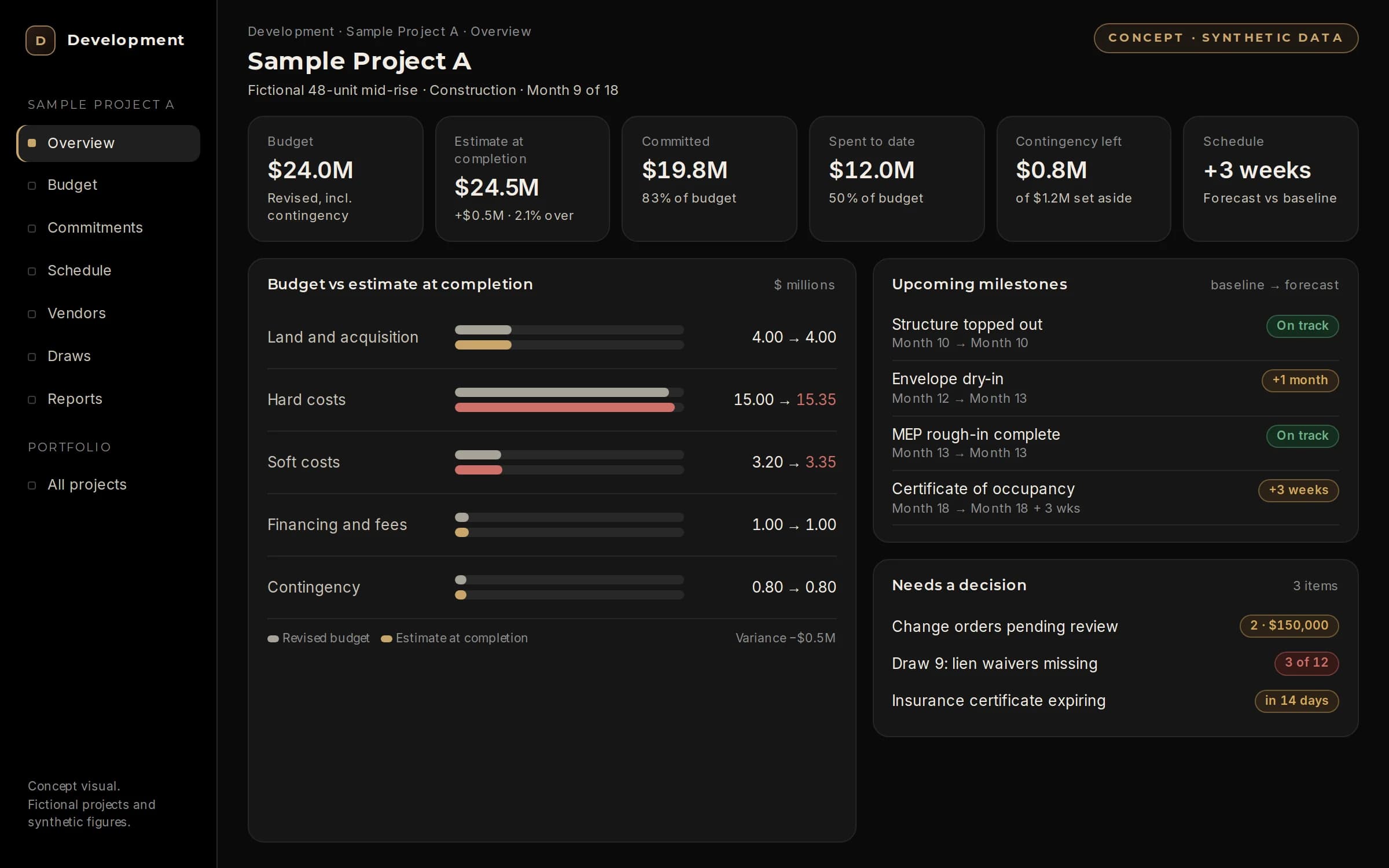
How a project dashboard could bring budget, forecast, contingency and schedule together. Synthetic figures for a fictional project.
Thirteen planned capabilities
Each one is described in detail on its area page. All are planned; none is available today.
Development Project DashboardStatus: Planned
Budget against estimate at completion, contingency, schedule and open items for each project.
Project Planning and MilestonesStatus: Planned
Phases, milestones and a baseline schedule, with forecast dates tracked against the plan.
Construction ManagementStatus: Planned
Progress, site reports, inspections, issues and documents recorded against each phase.
Development BudgetsStatus: Planned
Land, hard and soft costs by cost code, with contingency and approved revisions.
Cost Tracking and CommitmentsStatus: Planned
Contracts, invoices and actual costs against the budget, committed and uncommitted per line.
Contracts and Change OrdersStatus: Planned
Contract values and change orders, each traced to the budget lines it moves.
Vendor and Contractor ManagementStatus: Planned
Contractors, consultants and suppliers with scopes, insurance certificates and lien waivers.
Bidding and ProcurementStatus: Planned
Bid packages by scope, side-by-side comparison and a recorded selection decision.
Cash Flow ForecastingStatus: Planned
Month-by-month spending and sources of funds, updated as costs and dates change.
Lender Draw ManagementStatus: Planned
Prepare, document and track draw requests, with retainage and supporting documents.
Development Risk IntelligenceStatus: Planned
Explainable budget, contingency, schedule and draw signals, each with its rule shown.
Investor and Lender ReportingStatus: Planned
Periodic project status reports prepared from the project record.
Development Portfolio AnalyticsStatus: Planned
Budget, schedule and risk across every project in development, on the same measures.
Five areas
- Planning and OversightStatus: PlannedProject dashboard, planning and milestones, construction managementLearn more
- Budgets and CostsStatus: PlannedDevelopment budgets, cost tracking and commitments, contracts and change ordersLearn more
- Vendors and ProcurementStatus: PlannedVendor and contractor management, bidding and procurementLearn more
- Capital and DrawsStatus: PlannedCash flow forecasting, lender draw managementLearn more
- Risk and ReportingStatus: PlannedDevelopment risk intelligence, investor and lender reporting, portfolio analyticsLearn more
Principles we intend to keep
- One record per project. Budget, commitments, actual costs, schedule and documents tied to the same cost codes, so every figure can be traced to its source.
- Every figure labeled. An approved budget line, a signed commitment, an invoice, a forecast and your own assumption would never be mixed without saying which is which.
- Forecasts you can explain. An estimate at completion would show the lines and assumptions that produce it, not a single unexplained number.
- Deterministic calculations. Tested and versioned like the rest of the platform; no language model does arithmetic.
- A record, not a payment system. The platform is planned to track and document — not to hold, move or disburse money, approve loans or act as a contractor, lender, inspector or escrow agent.
What exists today
Development Management is planned and none of it is in the product. The stages before it are: research sites in Property Discovery Status: Available, model acquisitions in the Investment Analyzer Status: Available and track each opportunity in the Deal Pipeline Status: Available. Development and land feasibility models are planned separately Status: Planned. Solutions for developers
Questions
Can I manage a development project in Open Property Deals today?
Will Open Property Deals process lender draws or payments?
Is it meant to replace a contractor’s or a lender’s systems?
Are the screens on these pages real?
Tell us about the projects you run. It helps us decide what to build first.
Registering interest sends us a short note. It does not create an account, a reservation or a commitment of any kind.
Important
Development Management and every capability described on this page are planned. None of it is available in the product today, no launch date is committed, and scope may change or be dropped. As planned, Open Property Deals would keep a record of each project; it would not hold, move or disburse funds, originate or service loans, act as a contractor, inspector, escrow or title agent, or give investment, legal, tax, engineering or lending advice.
This capability is planned. It is a statement of intent, not a commitment; scope, timing and availability may change, and it may not be released.
Important
Open Property Deals is an information and analysis tool. It is not a broker, lender, investment adviser or listing service, and nothing on this site is an offer to buy or sell real estate or securities, or investment, legal or tax advice. Property records come from public sources and may be incomplete or out of date. Estimates and projections depend on assumptions that may prove wrong; real estate investing involves risk, including loss of capital. Verify every figure independently and consult licensed professionals before making a decision.